
If you're considering a dome home, glamping dome, or geodesic structure in Canada or the United States, understanding why domes outperform traditional square buildings is one of the most important things you can know before you build.
The Structural Problem with Square Buildings
Here's why:
In a square or rectangular building, load travels straight down. Snow piles on the roof, gravity pulls it down, and that force gets funneled toward the corners, the weakest points in any box-shaped frame. Flat roof panels flex. Wall joints strain. The heavier the load, the more concentrated the stress becomes at those vulnerable corners.
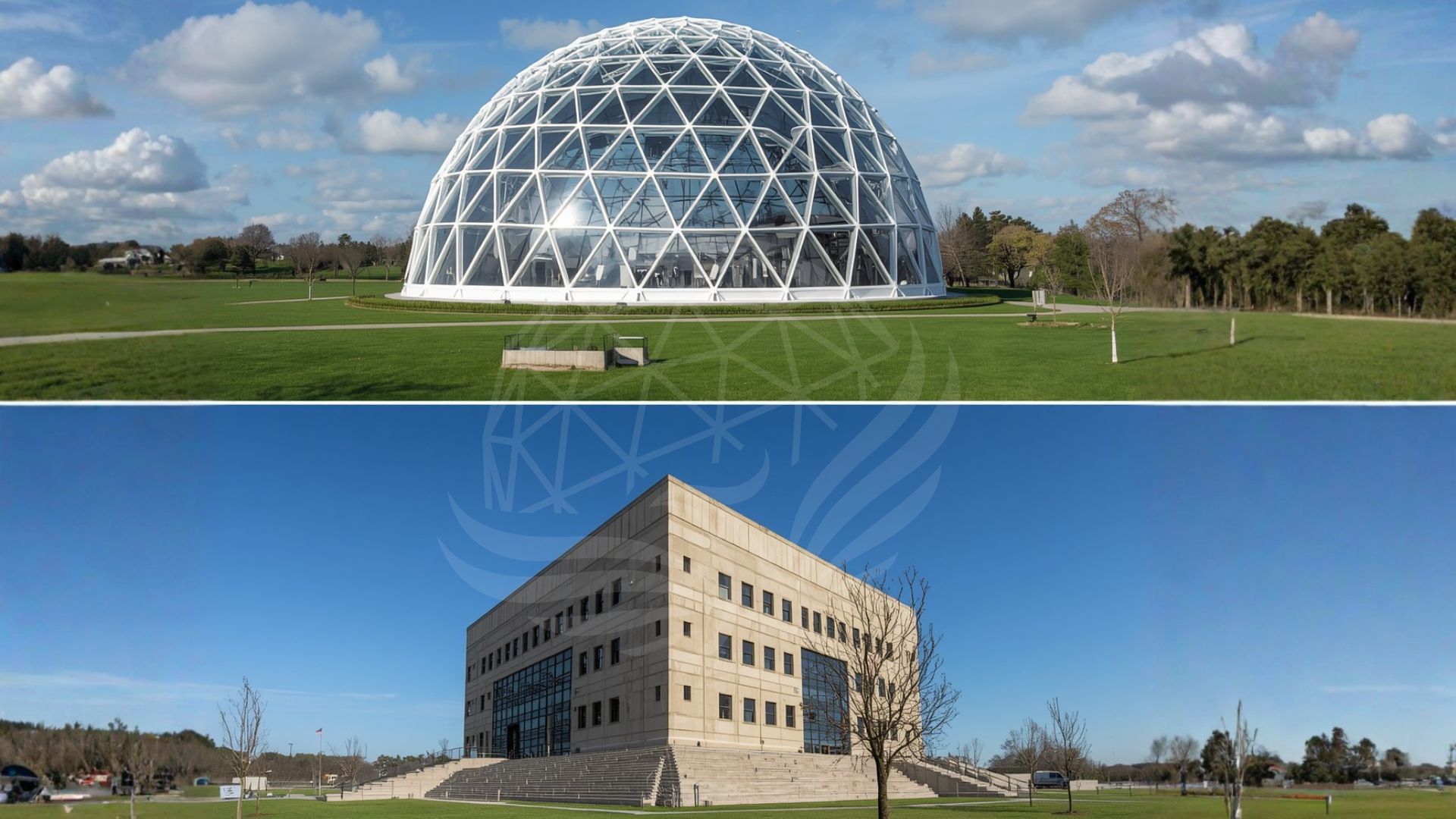
This is why traditional homes require heavy timber framing, sheathing, cross-bracing, reinforced trusses, and significant engineering just to survive a single Prairie winter or an Atlantic coastal storm. The box shape is fundamentally fighting against the forces of nature.
The Triangle Principle: Nature's Most Stable Shape
Geodesic domes are built on a different principle entirely — the triangle.
A triangle is the only geometric shape that cannot deform without changing the length of its sides. Unlike a square, which can collapse into a parallelogram under lateral pressure, a triangle holds its form absolutely. This is why triangles appear everywhere in nature and in engineering: from the structure of crystals to bridge trusses to the bones in your skeleton.
In a geodesic dome, hundreds of interlocking triangles cover the entire surface of the structure. Every triangle shares the load with its neighbors. When pressure is applied — whether from snow, wind, or seismic activity — that force doesn't collect in one place. It travels outward and downward along every single triangle simultaneously, distributing stress evenly across the whole structure.
The result: no single point bears the weight. The entire dome does.


Dome vs. Box: How Load Really Works
Here's a side-by-side breakdown of what happens when snow loads hit:
Rectangular Building | Geodesic Dome | |
Load direction | Pushes straight DOWN | Travels outward AND downward |
Stress concentration | Corners and joints | Distributed across all triangles |
Weak points | 4 corners, roof edges | None — every point shares equally |
Snow shedding | Flat surfaces accumulate snow | Curved surface sheds snow naturally |
Wind resistance | Flat walls catch gusts | Curved shape deflects wind around it |
The geodesic dome doesn't just handle loads better — it's structurally designed to eliminate the concept of a weak point altogether.
Engineered for Canadian Conditions
Phoenix Domes aren't designed for mild climates. They're built specifically for the harshest conditions that Canada can produce — from the snowbelt regions of the Rockies to the deep freeze of Quebec. Here's how the dome's geometry solves each major weather challenge:
Heavy Snow Loads
Mountain & Prairie Winters
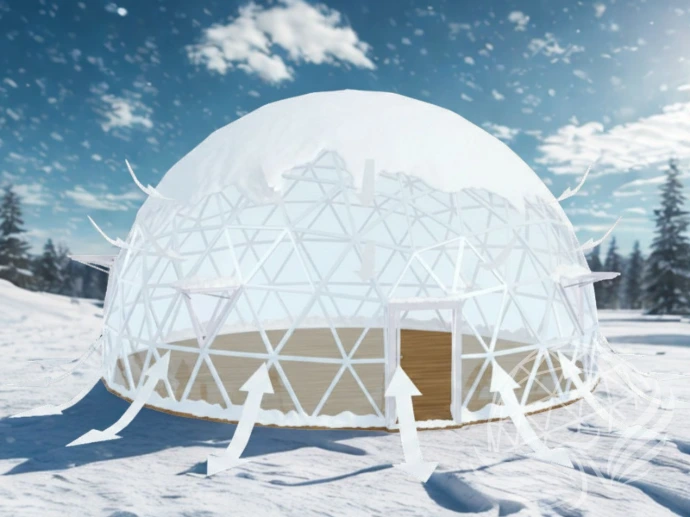
The curved surface of a geodesic dome causes snow to slide off naturally, rather than accumulating the way it does on flat or gently pitched roofs. And even when snow does build up, the triangular network distributes the weight so evenly that no single panel, joint, or connection point is overwhelmed. The dome as a whole handles it.


High Winds
Atlantic Coastal Storms
Flat walls are wind catchers. When a gust hits a conventional building, it slams into a broad, flat surface — creating enormous pressure that pushes at joints, windows, and corners. A geodesic dome has no flat face to catch wind. Its aerodynamic curved shape causes air to flow around the structure rather than against it, dramatically reducing wind resistance and uplift forces.
Extreme Cold
Quebec, Northern Canada, Alaska
Geometry helps here too. A dome encloses the maximum volume for the minimum surface area of any structure. Less surface area means less exposure to outside temperatures — and less heat loss. Phoenix Domes reinforce this natural advantage with Spray foam insulation, with no thermal bridging at joists or square corners.

Why This Matters for Dome Buyers in Canada and the US
Whether you're looking at a glamping dome in the Pacific Northwest, a year-round dome home in the Rockies, a backyard studio dome in around the Great Lakes, or a resort dome structure on the Atlantic Coast, structural performance is what separates a beautiful investment from a costly mistake.
Many buyers come to geodesic domes for the aesthetic — the striking silhouette, the panoramic feel, the connection to nature. But what keeps them confident over decades of harsh winters and stormy seasons is the engineering underneath.
Here are the key structural advantages that matter most for Dome buyers across Canada and the United States:
Snow load capacity far exceeding standard residential building requirements
Wind resistance that outperforms conventional framing in high-gust environments
Cold weather performance with insulation designed for sub-arctic temperatures
Long-term durability with fewer joints, fewer weak points, and less structural maintenance
Year-round usability without seasonal takedown or weatherproofing compromises
Frequently Asked Questions
Can a geodesic dome handle a Canadian winter?
Yes — geodesic domes are among the most winter-capable structures available. Their curved surfaces shed snow naturally, their triangular frames distribute load across the whole structure, and properly insulated domes (like those from Phoenix Domes, rated to -40°C) maintain comfortable interior temperatures even in Northern Canadian winters.

Are geodesic domes stronger than traditional homes?
In terms of structural efficiency — the ratio of strength to material used — geodesic domes are significantly stronger than box-frame construction. They distribute force across the entire structure rather than concentrating stress at corners and joints.
Do geodesic domes stand up to high winds?
Yes. The aerodynamic curved shape of a geodesic dome causes wind to flow around it rather than against it. There is no flat wall face to catch gusts, making domes particularly well-suited for coastal BC, Prairie storm corridors, and mountain environments across Canada and the US.


Are domes good for year-round use in Canada?
Absolutely. Phoenix Domes are engineered specifically for year-round Canadian use, with double pane glass windows and recommended insulation upgrades rated for extreme cold, snow-shedding geometry, and wind-resistant framing. They are not seasonal structures — they are permanent, all-weather buildings.
What sizes of geodesic domes are available?
Phoenix Domes offers a range of geodesic structures suited for glamping, residential use, commercial retreats, yoga studios, saunas, and more. Visit phoenixdomes.com to explore available models and configurations.

Ready to Build Stronger?
The strength of a geodesic dome isn't a coincidence — it's the result of geometry working in your favor rather than against you. From the triangle principle to aerodynamic wind deflection to maximum volume with minimum surface exposure, every aspect of the dome's shape makes it structurally superior to conventional square buildings.
At Phoenix Domes, we design geodesic structures built specifically for Canadian seasons. Year-round use. Year-round strength. No compromise.
Get in Touch → phoenixdomes.com
